How to Make Perfume Last Longer | 15 Expert Tips
Discover 15 proven ways to make your perfume last longer. Learn the best application techniques, storage tips, pulse points, layering methods, and common mistakes to avoid.
Kaif Shaikh
1/17/20267 min read
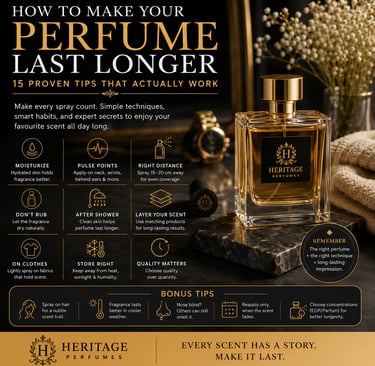
How to Make Your Perfume Last Longer: 15 Proven Tips That Actually Work
Have you ever applied your favourite perfume in the morning only to find that the fragrance seems to disappear within a few hours? You're not alone. One of the most common questions fragrance lovers ask is, "Why doesn't my perfume last?"
The truth is that the longevity of a perfume depends on much more than the fragrance itself. Your skin type, the weather, where you apply it, how you store it, and even your daily habits can all affect how long a scent stays with you.
Many people believe that spraying more perfume is the solution. In reality, proper application and understanding how fragrances work can make a much bigger difference than simply using more sprays.
In this guide, you'll discover practical, science-backed tips that can help your perfume last significantly longer without wasting a single drop.
What Determines How Long a Perfume Lasts?
Before learning the best techniques, it's important to understand why some perfumes naturally last longer than others.
A fragrance's longevity depends on several key factors:
The concentration of fragrance oils
The quality of ingredients
Your skin type
Weather and humidity
Application technique
Storage conditions
For example, perfumes with rich base notes like musk, oud, sandalwood, vanilla, and amber naturally remain on the skin much longer than fragrances built mainly around citrus or aquatic notes.
This doesn't mean fresh perfumes are low quality—they are simply designed to create a lighter, more refreshing experience.
Tip 1: Moisturize Your Skin Before Applying Perfume
Dry skin absorbs fragrance oils quickly, causing the scent to fade faster.
Moisturized skin creates a smoother surface that helps perfume molecules stay in place and evaporate more slowly.
For best results:
Apply an unscented moisturizer.
Wait a few minutes.
Spray your perfume afterward.
Many fragrance experts consider this one of the easiest ways to improve longevity.
Tip 2: Spray on Pulse Points
Pulse points are areas where blood vessels are close to the skin. These naturally warmer spots help release fragrance gradually throughout the day.
The best pulse points include:
Neck
Wrists
Behind the ears
Inside elbows
Collarbone
Behind the knees
These areas allow your perfume to develop beautifully without becoming overpowering.
Tip 3: Never Rub Your Wrists Together
This is one of the biggest perfume myths.
Many people spray perfume on both wrists and immediately rub them together.
Doing this creates friction that can affect the fragrance's opening and change the way it develops.
Instead, simply spray and allow the perfume to dry naturally.
Tip 4: Apply Perfume After Showering
The best time to wear perfume is immediately after a shower.
Clean skin is free from excess oil, dirt, and sweat, allowing fragrance to settle more evenly.
Your pores are also slightly more open after warm water, helping the scent develop naturally.
Tip 5: Spray From the Right Distance
Holding the bottle too close creates concentrated wet spots.
Holding it too far wastes perfume.
The ideal spraying distance is about 15–20 cm (6–8 inches) from your skin.
This provides even coverage without over-applying.
Tip 6: Don't Overspray
Using more perfume doesn't always make it last longer.
Too much fragrance can overwhelm your senses and those around you.
Most perfumes perform well with:
2–3 sprays for strong perfumes
4–5 sprays for lighter fragrances
The goal is to smell pleasant, not overpowering.
Tip 7: Apply Perfume to Clothing (Carefully)
Fabric often holds fragrance longer than skin because it doesn't produce natural oils.
However, always test first.
Some perfumes can stain delicate fabrics such as silk or light-colored clothing.
A light spray on a jacket, scarf, or cotton shirt can extend the scent significantly.
Tip 8: Layer Your Fragrance
One of the best-kept secrets in the fragrance world is layering. Layering means using products with the same or complementary scent profile to help your perfume last longer and smell more balanced.
A simple layering routine looks like this:
Use an unscented body wash or one with a similar fragrance.
Apply an unscented moisturizer or matching body lotion.
Spray your perfume on moisturized skin.
If available, use a matching body mist or deodorant.
Layering creates multiple fragrance layers that evaporate at different speeds, making the scent stay noticeable for longer.
Tip 9: Apply Perfume to Your Hair Carefully
Hair holds fragrance extremely well because its fibers trap scent molecules.
However, spraying alcohol-based perfume directly onto your hair every day may dry it out over time.
Instead, try one of these methods:
Spray perfume lightly onto your hairbrush before brushing.
Mist the perfume into the air and walk through it.
Use a hair perfume if available.
This provides a subtle scent trail whenever you move.
Tip 10: Store Your Perfume Correctly
Even the highest-quality perfume can lose its beauty if stored improperly.
Perfume is sensitive to:
Heat
Direct sunlight
Humidity
Temperature fluctuations
To protect your fragrance:
✔ Store it in a cool, dry place.
✔ Keep it away from bathroom steam.
✔ Leave it in its original box if possible.
✔ Always close the cap tightly after use.
Proper storage helps preserve both the scent and its longevity for years.
Tip 11: Understand Your Skin Type
Your skin type plays a surprisingly important role in how long a fragrance lasts.
Oily Skin
Natural oils help hold fragrance molecules, so perfumes often last longer.
Dry Skin
Perfume tends to evaporate faster.
If you have dry skin, moisturizing before applying perfume can significantly improve longevity.
Tip 12: Weather Affects Performance
Temperature changes how perfume behaves.
Summer
Heat causes fragrance molecules to evaporate more quickly.
Fresh citrus and aquatic perfumes feel refreshing but may not last as long.
Winter
Cool temperatures slow evaporation, allowing richer fragrances like vanilla, oud, sandalwood, amber, and musk to last much longer.
Choosing a perfume suited to the season often improves performance naturally.
Tip 13: Don't Become Nose Blind
Many people believe their perfume has disappeared when, in reality, they've simply become accustomed to the scent.
This phenomenon is called olfactory adaptation or nose blindness.
Your brain gradually stops paying attention to familiar smells, even though other people around you can still notice them.
This is why constantly reapplying perfume throughout the day isn't always necessary.
Tip 14: Choose the Right Perfume Concentration
Different perfume concentrations naturally last for different lengths of time.
TypeTypical LongevityEau de Cologne2–4 hoursEau de Toilette (EDT)4–6 hoursEau de Parfum (EDP)6–10 hoursParfum / Extrait8–12+ hours
If longevity is your priority, Eau de Parfum and Parfum generally provide better performance because they contain a higher percentage of fragrance oils.
Tip 15: Quality Matters More Than Quantity
A well-formulated perfume made with quality ingredients often performs better than simply using more sprays of a weaker fragrance.
Rich base notes such as musk, sandalwood, vanilla, patchouli, amber, and oud naturally extend a perfume's lifespan and create a smoother dry-down.
Rather than applying excessive amounts, choose fragrances known for balanced compositions and lasting performance.
Common Mistakes That Reduce Perfume Longevity
Avoid these habits if you want your fragrance to last:
Rubbing your wrists together.
Applying perfume to dirty or sweaty skin.
Storing bottles in direct sunlight.
Leaving perfumes in hot cars.
Using too many sprays.
Expecting fresh citrus fragrances to perform like heavy oud perfumes.
Forgetting to moisturize dry skin.
Small changes in your routine can noticeably improve performance.
Quick Recap
To make your perfume last longer:
✔ Moisturize your skin first.
✔ Apply perfume to pulse points.
✔ Don't rub your wrists.
✔ Spray after showering.
✔ Layer your fragrance.
✔ Store perfumes correctly.
✔ Choose the right concentration.
✔ Understand your skin type.
✔ Apply thoughtfully rather than excessively.
Expert Tips from Professional Perfumers
Professional perfumers know that making a fragrance last isn't about applying more perfume—it's about applying it intelligently.
Here are some expert recommendations:
Apply Perfume Before Getting Dressed
Spraying perfume directly onto your skin before putting on clothes helps the fragrance settle naturally. This also reduces the risk of staining delicate fabrics.
Spray Multiple Pulse Points
Instead of applying five sprays to one area, distribute them across different pulse points.
For example:
One spray on the neck
One behind each ear
One on each wrist
This creates a balanced scent that develops naturally throughout the day.
Don't Shake the Bottle
Many people shake perfume bottles before use.
Unlike some cosmetic products, perfumes don't need shaking. Excessive agitation may introduce tiny air bubbles, which isn't necessary and offers no benefit.
Simply spray as intended.
Let the Fragrance Settle
After applying perfume, allow it to dry naturally.
Avoid touching the area or rubbing it.
This preserves the intended development of the fragrance from top notes to base notes.
Ingredients That Naturally Last Longer
Certain fragrance ingredients are known for exceptional longevity.
If you prefer perfumes that stay noticeable throughout the day, look for these notes:
Oud
Rich, woody, smoky, and luxurious.
One of the longest-lasting ingredients in perfumery.
Musk
Soft, clean, and comforting.
Excellent for extending fragrance longevity.
Sandalwood
Creamy, woody, and elegant.
Provides a smooth and long-lasting dry-down.
Vanilla
Sweet, warm, and comforting.
Adds richness and helps fragrances remain noticeable for many hours.
Amber
Warm, resinous, and slightly sweet.
Commonly used in evening fragrances because of its excellent lasting power.
Patchouli
Earthy and woody.
Adds depth while improving overall fragrance performance.
Common Myths About Perfume Longevity
Many perfume users believe things that simply aren't true.
Let's separate fact from fiction.
Myth 1: More Sprays Mean Longer Performance
Not necessarily.
Once your skin reaches a certain amount of fragrance, adding more perfume mainly increases the initial intensity—not the overall longevity.
Myth 2: Expensive Perfumes Always Last Longer
Price alone doesn't determine performance.
A well-formulated perfume with quality ingredients often performs better than an expensive fragrance that isn't suited to your skin or climate.
Myth 3: You Should Reapply Every Hour
Most quality perfumes don't require frequent reapplication.
Often, you've simply become accustomed to the scent, while others can still smell it.
Myth 4: Perfume Never Expires
Perfume doesn't spoil overnight, but exposure to sunlight, heat, and air gradually changes the fragrance over time.
Proper storage significantly extends its life.
Frequently Asked Questions
Why can't I smell my perfume after a few hours?
Your brain naturally adapts to familiar scents. This is called olfactory adaptation or nose blindness. Other people may still notice your fragrance even when you cannot.
Should I spray perfume on my clothes?
You can, but always test first. Some perfumes may stain delicate fabrics such as silk or light-colored clothing.
Does moisturizing really make a difference?
Yes.
Moisturized skin helps fragrance molecules remain on the surface longer, allowing the perfume to evaporate more slowly.
Which perfumes usually last the longest?
Fragrances containing oud, sandalwood, musk, vanilla, amber, and patchouli generally provide better longevity than fragrances dominated by citrus or aquatic notes.
Is perfume longevity the same as projection?
No.
Longevity refers to how long a fragrance remains noticeable.
Projection describes how far the scent radiates from your body.
A perfume may last all day while remaining close to the skin.
Final Thoughts
Making your perfume last longer isn't about using more fragrance—it's about understanding how perfumes interact with your skin, your environment, and your daily routine.
Simple habits such as moisturizing before application, spraying on pulse points, storing bottles correctly, and choosing the right perfume concentration can noticeably improve performance without wasting fragrance.
It's also important to remember that every perfume is designed differently. Fresh citrus fragrances naturally feel lighter, while woody, musky, amber, and vanilla-based perfumes are intended to provide greater depth and longevity.
The best approach is to choose a fragrance that suits your lifestyle, apply it correctly, and enjoy how it develops throughout the day.
With proper care and application, your favourite perfume can continue leaving a memorable impression long after you've applied it.