Perfume Concentrations Explained | Parfum, EDP, EDT & Cologne Guide
Confused about Parfum, Eau de Parfum, Eau de Toilette and Cologne? Learn the differences, longevity, fragrance oil concentration, and which type is best for you.
Kaif Shaikh
1/23/20267 min read
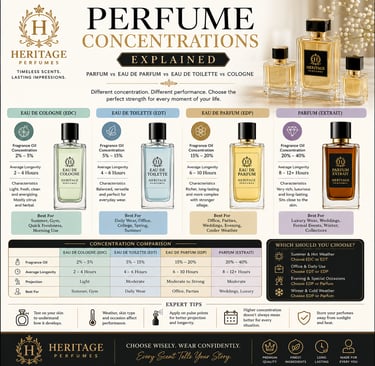
Perfume Concentrations Explained: Parfum vs Eau de Parfum vs Eau de Toilette vs Cologne
Have you ever picked up a perfume bottle and noticed terms like Parfum, Eau de Parfum (EDP), Eau de Toilette (EDT), or Eau de Cologne (EDC)? If you're new to fragrances, these names can be confusing. Many people assume they refer to completely different perfumes, but in reality, they describe the strength and concentration of fragrance oils inside the bottle.
Understanding perfume concentrations is one of the most important steps in choosing a fragrance that suits your lifestyle, budget, and expectations. A perfume with a higher concentration of fragrance oils generally lasts longer and develops more slowly, while lighter concentrations provide a fresh and refreshing experience.
In this guide, we'll explain each concentration in simple terms, compare their longevity, help you understand when to wear them, and show you which option may be best for your daily routine.
What Is Perfume Concentration?
Perfume concentration refers to the percentage of aromatic fragrance oils mixed with alcohol and other ingredients. This percentage directly affects how intense a perfume smells, how long it lasts, and how it develops throughout the day.
Generally, perfumes with a higher oil concentration have:
Better longevity
Richer scent development
Less need for reapplication
Greater depth during the dry-down
Lower concentrations feel lighter, fresher, and are often preferred in hot weather or for casual daily use.
It is important to remember that higher concentration does not always mean a perfume is better. The best choice depends on your personal preference, the occasion, and the climate.
Why Are There Different Perfume Concentrations?
Not everyone wants a perfume that lasts twelve hours. Some people prefer a fresh, subtle scent for the office, while others want a rich fragrance that lasts through weddings, parties, or evening events.
Different perfume concentrations allow fragrance houses to create options for every lifestyle.
For example:
A student attending college may prefer a lighter Eau de Toilette.
Someone attending a wedding may choose an Eau de Parfum.
A collector looking for maximum richness may invest in a Parfum.
Understanding these options helps you make smarter purchasing decisions.
The Four Main Perfume Concentrations
The perfume industry generally divides fragrances into four major categories:
Eau de Cologne (EDC)
Eau de Toilette (EDT)
Eau de Parfum (EDP)
Parfum (Extrait de Parfum)
Each category contains a different percentage of fragrance oils.
Let's understand them one by one.
Eau de Cologne (EDC)
Eau de Cologne is the lightest of the four major perfume concentrations.
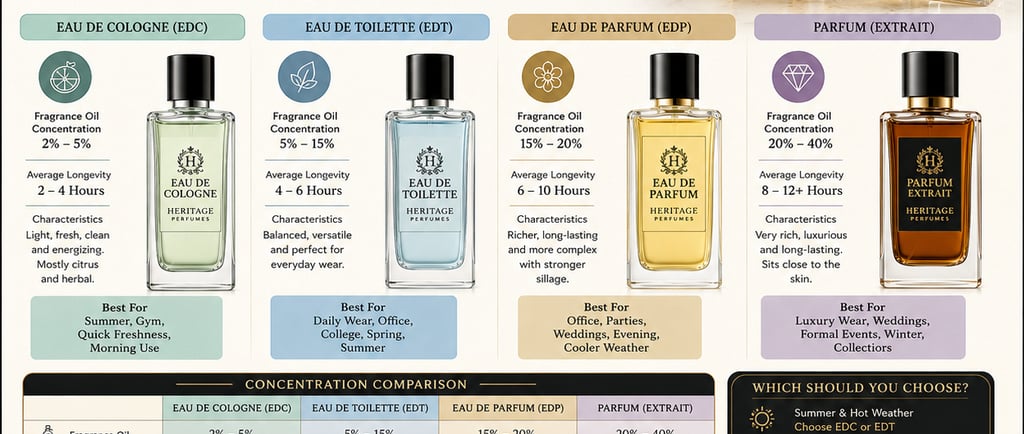
Fragrance Oil Concentration
Approximately 2%–5%
Average Longevity
Around 2 to 4 hours
Characteristics
Eau de Cologne feels extremely fresh, clean, and energizing.
It usually contains bright citrus ingredients such as:
Lemon
Orange
Bergamot
Neroli
Herbs
Because of its light concentration, it is often reapplied during the day.
Best For
Hot summer weather
Gym
Casual outings
Quick freshness
Morning use
Cologne is an excellent choice if you enjoy refreshing fragrances that never feel heavy.
Eau de Toilette (EDT)
Eau de Toilette is one of the most popular perfume concentrations in the world.
Fragrance Oil Concentration
Approximately 5%–15%
Average Longevity
Around 4 to 6 hours
Characteristics
EDTs provide a balance between freshness and performance.
They usually have:
Bright openings
Moderate projection
Comfortable wear
Good versatility
Many everyday fragrances are released as Eau de Toilette because they work well in offices, colleges, and daytime environments.
Best For
Daily wear
Office
College
Spring
Summer
If you're looking for an everyday perfume, Eau de Toilette is often a great starting point.
Eau de Parfum (EDP)
Eau de Parfum, commonly known as EDP, is one of the most popular perfume concentrations today. It offers an excellent balance between longevity, projection, and everyday wearability, making it a favorite choice for fragrance enthusiasts.
Fragrance Oil Concentration
Approximately 15%–20%
Average Longevity
Typically 6 to 10 hours, depending on the fragrance, your skin type, and the weather.
Characteristics
Compared to Eau de Toilette, Eau de Parfum contains a higher concentration of fragrance oils. This allows the scent to develop more slowly and remain noticeable for much longer.
Most EDPs have:
Richer heart notes
Stronger base notes
Better longevity
Moderate to strong projection
Smooth scent development
Unlike lighter fragrances that fade quickly, Eau de Parfum evolves beautifully throughout the day, revealing different layers of the fragrance.
Best For
Daily wear
Office
Weddings
Parties
Evening events
Cooler weather
If you want one perfume that performs well in most situations, Eau de Parfum is often the best choice.
Parfum (Extrait de Parfum)
Parfum, also known as Extrait de Parfum, represents the highest fragrance concentration commonly available.
Fragrance Oil Concentration
Approximately 20%–40%
Average Longevity
Generally 8 to 12 hours, with some luxury parfums lasting well over 24 hours on clothing.
Characteristics
Parfum contains the highest percentage of fragrance oils and the lowest percentage of alcohol.
As a result, it usually feels:
Richer
Softer
Smoother
More luxurious
Because of the higher oil concentration, Parfum often sits closer to the skin while lasting much longer than lighter perfume types.
It doesn't necessarily project farther than Eau de Parfum—it simply remains noticeable for a longer period.
Best For
Luxury fragrance lovers
Weddings
Formal events
Winter
Evening wear
Collectors
Parfum is ideal for those who appreciate depth, elegance, and long-lasting performance.
Perfume Concentration Comparison Table
TypeFragrance OilAverage LongevityProjectionBest ForEau de Cologne (EDC)2–5%2–4 HoursLightSummer, GymEau de Toilette (EDT)5–15%4–6 HoursModerateDaily WearEau de Parfum (EDP)15–20%6–10 HoursModerate to StrongOffice, PartiesParfum20–40%8–12+ HoursModerateWeddings, Luxury Wear
Which Perfume Concentration Should You Choose?
Choosing the right concentration depends on your lifestyle rather than simply buying the strongest option.
For Everyday Use
An Eau de Toilette offers freshness, comfort, and affordability.
For Office
A light Eau de Parfum works beautifully because it lasts throughout the workday without becoming overwhelming.
For Weddings & Special Occasions
Parfum or a high-quality Eau de Parfum provides better longevity and richer scent development.
For Summer
Fresh Eau de Cologne and Eau de Toilette feel lighter and more refreshing in hot weather.
For Winter
Richer Eau de Parfum and Parfum perform exceptionally well because cooler temperatures slow fragrance evaporation.
Does Higher Concentration Always Mean Better?
Many beginners believe the strongest perfume is automatically the best.
This isn't true.
A fragrance should match:
Your personality
Your environment
The weather
The occasion
Your personal taste
A refreshing citrus Eau de Toilette may be perfect for a hot summer afternoon, while a heavy Parfum could feel too intense in the same situation.
The "best" concentration is simply the one that fits your needs.
Projection vs Longevity
People often confuse projection with longevity, but they are different.
Projection
Projection refers to how far a fragrance radiates from your body.
A perfume with strong projection is noticeable from a greater distance.
Longevity
Longevity refers to how long the perfume remains noticeable on your skin or clothing.
A perfume may last for ten hours while staying close to the skin, whereas another fragrance may project strongly for two hours but fade sooner.
Understanding this difference helps you choose perfumes based on your expectations.
Common Mistakes When Choosing Perfume Strength
Avoid these common mistakes:
❌ Buying the strongest concentration without considering your lifestyle.
❌ Assuming expensive Parfum is always better.
❌ Ignoring weather conditions.
❌ Judging a perfume only by the first spray.
❌ Expecting every perfume to last all day regardless of its concentration.
Instead, focus on choosing a fragrance that suits your daily routine and preferences.
Common Myths About Perfume Concentrations
There are many misconceptions about perfume concentrations. Let's separate fact from fiction.
Myth 1: Higher Concentration Always Smells Better
This is one of the biggest myths in the fragrance world.
A higher concentration simply means there is a larger percentage of fragrance oils in the formula. It does not automatically make the perfume smell better.
Some Eau de Toilette fragrances are beautifully fresh and vibrant, while certain Parfums are intentionally soft and intimate. The quality of the ingredients, the skill of the perfumer, and the fragrance composition matter far more than concentration alone.
Myth 2: Parfum Always Projects More
Many people assume that because Parfum contains more fragrance oils, it must project farther.
In reality, Parfum often sits closer to the skin. Its higher oil concentration allows it to evaporate more slowly, creating excellent longevity rather than extreme projection.
If you want a perfume that fills a room, concentration alone isn't the deciding factor—the fragrance formula plays a much bigger role.
Myth 3: Eau de Toilette Doesn't Last
Not true.
Many high-quality Eau de Toilette fragrances easily last 5–7 hours, especially in cooler weather or on well-moisturized skin.
Longevity depends on:
Skin type
Climate
Fragrance ingredients
Storage
Application technique
Myth 4: More Sprays Make a Perfume Last Longer
Applying ten sprays instead of four usually doesn't double the longevity.
Instead, it often creates an overly strong opening while offering little improvement in overall performance.
Choosing the right concentration and applying it correctly is much more effective.
Which Concentration Is Right for You?
Everyone's lifestyle is different.
Here's a simple guide.
College Students
Choose:
✔ Eau de Toilette
It feels fresh, comfortable, and works well for everyday activities.
Office Professionals
Choose:
✔ Eau de Parfum
It provides better longevity without becoming overpowering.
Weddings & Special Occasions
Choose:
✔ Eau de Parfum
or
✔ Parfum
These richer concentrations stay noticeable for long events and develop beautifully over time.
Summer Weather
Choose:
✔ Eau de Cologne
or
✔ Eau de Toilette
These lighter fragrances feel refreshing and comfortable in warm temperatures.
Winter Weather
Choose:
✔ Eau de Parfum
or
✔ Parfum
Cold weather allows richer fragrances to shine and improves their longevity.
Expert Buying Tips
Buying a perfume isn't just about selecting the highest concentration.
Keep these tips in mind:
Test Before Buying
Always test a perfume on your own skin. Skin chemistry affects how every fragrance develops.
Consider the Occasion
Fresh fragrances work beautifully during the day, while richer perfumes often suit evenings and celebrations.
Read the Notes
Understanding top, heart, and base notes gives you a much better idea of how the fragrance will evolve.
Store Perfume Properly
Keep your perfume away from sunlight, excessive heat, and humidity to preserve its original quality.
Don't Follow Trends Blindly
A fragrance that suits someone else may not suit your personality or lifestyle.
Choose the perfume that makes you feel confident.
Frequently Asked Questions
What is the strongest type of perfume?
Parfum (also called Extrait de Parfum) generally has the highest fragrance oil concentration and usually offers the longest longevity.
Is Eau de Parfum better than Eau de Toilette?
Not necessarily.
Eau de Parfum typically lasts longer, but Eau de Toilette often feels lighter and fresher, making it perfect for daytime wear and hot weather.
How many sprays should I use?
Most perfumes perform well with:
Eau de Cologne: 4–6 sprays
Eau de Toilette: 3–5 sprays
Eau de Parfum: 2–4 sprays
Parfum: 1–3 sprays
These are general guidelines and can vary depending on the fragrance.
Does perfume concentration affect projection?
Partially.
Concentration influences how a fragrance develops, but the ingredients and formulation also determine how far the scent projects.
Can I wear Eau de Parfum every day?
Absolutely.
Many modern Eau de Parfum fragrances are designed specifically for everyday use and offer an excellent balance of performance and comfort.
Final Thoughts
Understanding perfume concentrations helps you choose fragrances with confidence. Rather than assuming the strongest option is always the best, consider how and where you'll wear your perfume.
If you enjoy light, refreshing scents for everyday use, Eau de Toilette may be the ideal choice. If you're looking for richer fragrances with longer-lasting performance, Eau de Parfum offers excellent versatility. For those who appreciate luxury and maximum longevity, Parfum provides a deeper and more refined fragrance experience.
The perfect perfume concentration is the one that fits your lifestyle, matches the occasion, and makes you feel comfortable every time you wear it.
As you build your fragrance collection, understanding these differences will help you make smarter choices and enjoy every bottle to its fullest.
Quick Summary
✔ Eau de Cologne (EDC): Fresh, light, 2–4 hours.
✔ Eau de Toilette (EDT): Everyday wear, 4–6 hours.
✔ Eau de Parfum (EDP): Balanced, versatile, 6–10 hours.
✔ Parfum: Rich, luxurious, 8–12+ hours.
✔ Higher concentration doesn't always mean better.
✔ Choose a perfume based on your lifestyle, weather, and occasion.