
Perfume Notes Explained | Top, Heart & Base Notes Guide
Learn how perfume notes work, including top, heart, and base notes. Discover why fragrances change over time and how to choose the perfect scent with this complete beginner's guide.
Kaif Shaikh
1/11/20267 min read
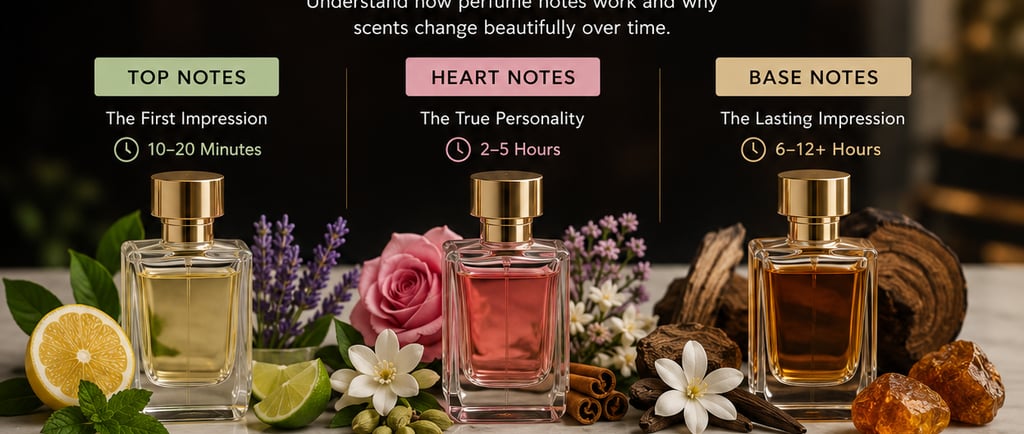

Perfume Notes Explained: Top, Heart & Base Notes – The Complete Guide
Imagine spraying a perfume in the morning and noticing that it smells bright and fresh. A few hours later, the fragrance becomes softer, warmer, and deeper. By evening, it transforms once again into a smooth, long-lasting scent that stays close to your skin.
This isn't magic—it's the art and science of perfume notes.
Every quality perfume is carefully designed to evolve over time. Instead of smelling exactly the same from the first spray to the last, a fragrance reveals different layers, creating a richer and more enjoyable experience. These layers are known as top notes, heart notes, and base notes.
Understanding perfume notes is one of the most important steps in choosing the right fragrance. Once you know how they work, you'll be able to shop more confidently, understand fragrance descriptions, and even predict how a perfume will smell throughout the day.
In this guide, we'll explain perfume notes in simple language, explore how they develop, and help you discover which notes suit your personality and lifestyle.
What Are Perfume Notes?
Perfume notes are the individual scent layers that make up a fragrance. Instead of releasing every ingredient at once, perfumes are created so that different aromas appear gradually over time.
Think of a perfume like a musical performance.
The opening notes grab your attention, the middle creates the melody, and the ending leaves a lasting impression.
Perfumers carefully select ingredients with different evaporation rates. Some ingredients evaporate quickly, while others remain on the skin for many hours. This natural process creates the beautiful transition that makes perfumes feel alive and dynamic.
Without perfume notes, every fragrance would smell flat and one-dimensional.
Why Do Perfumes Change Over Time?
One of the most common questions people ask is:
"Why doesn't my perfume smell the same after an hour?"
The answer lies in the evaporation speed of fragrance ingredients.
Light citrus oils and herbs evaporate very quickly. Floral ingredients last longer. Rich woods, musk, amber, vanilla, and resins evaporate slowly, allowing them to remain on the skin for many hours.
This gradual evaporation is what creates the fragrance journey.
A well-crafted perfume doesn't lose its beauty as time passes—it simply tells a different chapter of its story.
Understanding the Perfume Pyramid
Most perfumes are structured like a pyramid with three distinct layers.
TOP NOTES
(First Impression)
HEART NOTES
(The Main Personality)
BASE NOTES
(Long-Lasting Foundation)
Each layer plays an important role in how the perfume develops and how long it lasts.
Top Notes – The First Impression
Top notes are the first scents you notice immediately after spraying a perfume. They create your initial impression and are designed to feel fresh, bright, and inviting.
Because these ingredients are light and highly volatile, they usually last only 10 to 20 minutes before gradually fading away.
Common top notes include:
Bergamot
Lemon
Orange
Grapefruit
Mandarin
Mint
Basil
Lavender
Top notes are often chosen to make a fragrance feel energetic and refreshing.
However, it's important not to judge a perfume based only on its opening because the true character of the fragrance appears later.
Heart Notes – The Soul of Every Perfume
Once the fresh top notes begin to fade, the perfume reveals its true personality through the heart notes, also known as the middle notes. This stage usually begins around 15–30 minutes after application and can remain noticeable for 2 to 5 hours, depending on the fragrance composition and concentration.
Heart notes make up the largest portion of a perfume. They connect the freshness of the opening with the richness of the base, creating a smooth transition that feels balanced and natural.
When someone says, "I love how this perfume smells," they are often describing its heart notes.
Common Heart Notes
Some of the most popular middle notes include:
Rose
Jasmine
Mogra
Lily of the Valley
Orange Blossom
Geranium
Lavender
Cinnamon
Cardamom
Nutmeg
These ingredients add elegance, warmth, spice, or softness depending on the perfume's style.
Floral Heart Notes
Floral notes are among the most widely used in perfumery because they create timeless, elegant fragrances.
For example:
Rose adds romance and sophistication.
Jasmine feels rich, creamy, and luxurious.
Mogra creates a fresh yet traditional floral aroma.
Orange Blossom provides brightness and sweetness.
These notes are commonly found in perfumes designed for everyday wear, weddings, and special occasions.
Spicy Heart Notes
Spices bring warmth and character to a fragrance.
Examples include:
Cardamom
Cinnamon
Nutmeg
Black Pepper
Clove
Spicy perfumes often feel bold, mature, and luxurious, making them popular during colder months.
Fruity Heart Notes
Many modern perfumes combine floral ingredients with fruity accords to create a youthful and energetic scent.
Popular fruity notes include:
Apple
Pear
Peach
Plum
Blackcurrant
These ingredients create a playful and vibrant personality while maintaining elegance.
Base Notes – The Foundation of Every Great Perfume
As the heart notes slowly fade, the fragrance settles into its base notes.
This final stage can remain on your skin for 6 to 12 hours, and in some premium perfumes, even longer.
Base notes are responsible for:
Longevity
Depth
Smoothness
Warmth
Lasting impression
Without strong base notes, a perfume would disappear quickly and feel incomplete.
Common Base Notes
Some of the most respected base ingredients include:
Oud
Oud is one of the world's most luxurious fragrance ingredients.
It creates a rich, woody, smoky, and slightly sweet aroma that is highly valued in Middle Eastern and premium fragrances.
Sandalwood
Sandalwood produces a creamy, smooth, woody scent that blends beautifully with floral and spicy notes.
It adds elegance without becoming overpowering.
Musk
Musk provides warmth and softness.
Modern musks are clean, comforting, and often create the feeling of freshly washed skin.
They also help extend the life of a perfume.
Amber
Amber adds warmth, sweetness, and richness.
Although amber isn't a single natural ingredient, it represents a blend of warm balsamic accords that create luxurious depth.
Vanilla
Vanilla brings sweetness, creaminess, and comfort.
It's one of the most loved base notes because it blends well with floral, woody, and spicy fragrances.
Patchouli
Patchouli offers an earthy, woody aroma with slightly sweet undertones.
It gives perfumes excellent depth and longevity.
Why Base Notes Last the Longest
Base note molecules are larger and heavier than citrus or floral molecules.
Because they evaporate slowly, they remain on your skin much longer.
This is why you may still smell hints of musk, sandalwood, vanilla, or oud several hours after applying your perfume.
The quality of the base often determines whether a perfume feels luxurious or forgettable.
How Perfumers Build a Balanced Fragrance
Creating a perfume is similar to composing music.
Perfumers carefully balance three layers so the fragrance changes naturally throughout the day.
A typical fragrance might look like this:
Top Notes
Bergamot
Lemon
Mint
↓
Heart Notes
Jasmine
Lavender
Cardamom
↓
Base Notes
Musk
Sandalwood
Vanilla
Each stage supports the next, creating a smooth transition rather than an abrupt change.
This layered structure is what makes fine fragrances feel sophisticated.
Why You Should Never Judge a Perfume Immediately
Many people smell only the opening of a perfume and decide they don't like it.
This is one of the biggest mistakes beginners make.
The opening lasts only a few minutes.
The real personality of a fragrance develops over time.
Experts recommend waiting at least 30 minutes before deciding whether a perfume suits you.
For expensive perfumes, wearing the fragrance for an entire day provides the best understanding of its character and performance.
Quick Summary
Top Notes: First impression (10–20 minutes)
Heart Notes: Main personality (2–5 hours)
Base Notes: Lasting foundation (6–12+ hours)
Understanding these three stages helps you choose perfumes more confidently and appreciate how expertly crafted fragrances evolve throughout the day.
How to Identify Perfume Notes Like a Professional
One of the most exciting parts of learning about fragrances is training your nose to recognize different notes. At first, every perfume may simply smell "good" or "strong," but with practice, you'll begin to notice the individual ingredients that make each fragrance unique.
The best way to develop this skill is by smelling perfumes slowly and paying attention to how they change over time.
For example:
Immediately after spraying, you may notice a fresh burst of citrus.
After 20–30 minutes, soft floral or spicy notes begin to appear.
Several hours later, warm woods, musk, or vanilla remain on the skin.
By observing these changes, you can identify the top, heart, and base notes more easily.
A helpful tip is to smell natural ingredients individually whenever possible. Smell a fresh lemon, rose petals, vanilla pods, sandalwood, or coffee beans. Familiarity with these scents makes it much easier to recognize them in perfumes.
Most Popular Perfume Notes and Their Characteristics
Understanding common fragrance notes helps you choose perfumes that match your taste.
Perfume NoteSmell ProfileBest ForBergamotFresh, citrusyDaily wearLemonBright, cleanSummerOrangeSweet citrusCasual useLavenderFresh, aromaticOfficeRoseElegant, romanticWeddingsJasmineRich floralEveningMograTraditional floralDaily & festiveCardamomWarm spiceWinterCinnamonSweet spiceEveningSandalwoodCreamy woodyFormal occasionsOudRich, luxuriousSpecial occasionsVanillaSweet, comfortingWinterMuskSoft, cleanEveryday wearAmberWarm, resinousNighttimePatchouliEarthy, woodyLuxury fragrances
Remember, most perfumes combine many of these notes to create a balanced and unique fragrance.
Common Myths About Perfume Notes
There are many misconceptions about how perfumes work. Let's clear up a few.
Myth 1: A Perfume Should Smell the Same All Day
False.
A quality perfume is designed to evolve. The changing scent is a sign of good craftsmanship, not poor quality.
Myth 2: Stronger Means Better
Not always.
A well-balanced perfume with moderate projection is often more enjoyable than one that overwhelms everyone around you.
Myth 3: Expensive Perfumes Always Last Longer
Price doesn't always determine performance.
Longevity depends on the ingredients, concentration, formulation, and even your skin type.
Myth 4: Men and Women Must Wear Different Notes
Modern perfumery is increasingly unisex.
Many notes such as sandalwood, citrus, musk, vanilla, oud, and amber are loved by everyone.
The best perfume is simply the one you enjoy wearing.
Expert Tips for Choosing Perfumes Based on Notes
When shopping for a new fragrance, don't focus only on the opening.
Instead:
Read the complete list of notes.
Understand the fragrance family.
Consider where you'll wear it.
Test it on your skin.
Wait for the dry-down before making a decision.
If you know you enjoy vanilla and sandalwood, look for perfumes that feature these as base notes. If you prefer fresh fragrances, choose perfumes with citrus and aquatic openings.
Understanding notes allows you to buy perfumes with greater confidence.
Frequently Asked Questions
How many notes does a perfume usually have?
Most perfumes contain dozens of ingredients, but only the most prominent notes are listed in product descriptions.
Can two perfumes have the same notes but smell different?
Yes.
The proportions, quality of ingredients, blending techniques, and supporting notes all influence the final fragrance.
Are perfume notes natural?
Some notes come from natural sources such as flowers, woods, and spices, while others are created using safe, high-quality aroma molecules. Both are widely used in modern perfumery.
Which perfume notes last the longest?
Generally, base notes such as oud, musk, sandalwood, patchouli, amber, and vanilla remain on the skin much longer than citrus or floral top notes.
Why do I stop smelling my own perfume?
This is called olfactory adaptation. Your brain gradually becomes accustomed to familiar scents and begins to ignore them, even though other people can still smell your perfume.
Final Thoughts
Perfume is much more than a pleasant scent—it's a carefully crafted composition that unfolds over time. By understanding top, heart, and base notes, you'll appreciate why fragrances evolve and how perfumers create memorable experiences.
Learning about perfume notes also makes shopping easier. Instead of choosing a fragrance based only on its bottle or popularity, you'll be able to select perfumes that genuinely match your personality, preferences, and lifestyle.
Whether you're drawn to fresh citrus openings, elegant floral hearts, or warm woody bases, every perfume tells its own story. Understanding these layers helps you enjoy that story from the very first spray to the final lingering notes.
Quick Summary
Top Notes: The fresh first impression, lasting around 10–20 minutes.
Heart Notes: The main personality of the perfume, lasting 2–5 hours.
Base Notes: The long-lasting foundation, providing depth and longevity.
Test perfumes on your skin and allow them time to develop before making a decision.
Learning fragrance notes helps you choose perfumes more confidently and build a collection you'll truly enjoy.